


Qilin operates as a ransomware-as-a-service (RaaS) platform, with operators who maintain the payload and supporting infrastructure, recruit affiliates, and collect a percentage of ransom payments. When major ransomware operations, like LockBit, RansomHub, and ALPHV/BlackCat, collapsed, were dismantled, or went dark throughout 2024 and into 2025, displaced affiliates needed somewhere to go, and Qilin had the infrastructure, recruitment pipeline, and revenue model to compete for them.
The operation has expanded its targeting, grown its ransomware affiliate program, and built an extortion model that goes well beyond encryption. MOXFIVE tracking shows Qilin operators have claimed approximately 1,500 victims since launch, with more than 500 in 2026 alone, making it the most active ransomware operation in our dataset. (See the MOXFIVE Threat Actor Spotlight on Qilin for additional tracking and affiliate analysis.)
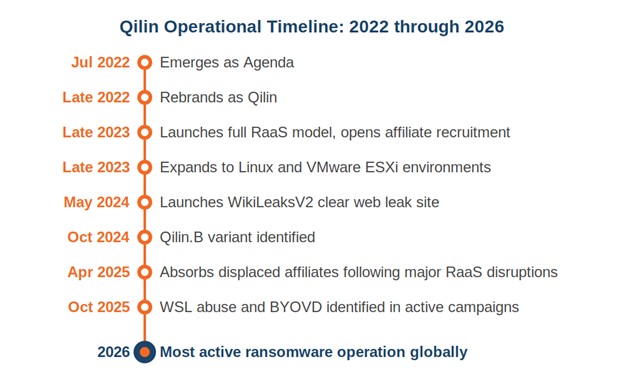
Qilin operates under the RaaS model, meaning the operators behind the operation develop and maintain the infrastructure while affiliates carry out attacks against victim organizations. That division of labor allows the operation to support more activity than a closed ransomware group could likely sustain on its own. Affiliates earn between 80 and 85 percent of each ransom payment, with operators retaining the remainder, a split that positions QiIlin as one of the more financially attractive programs available to threat actors in the market. Recruitment is conducted through RAMP, a Russian-language cybercrime forum, giving operators access to an established base of potential affiliates.
Originally launched in 2022 under the name Agenda, the operation rebranded as Qilin and rewrote its codebase in Rust before expanding into a mature RaaS platform. The payload targets Windows, Linux, and VMware ESXi environments, a combination that puts virtualized enterprise infrastructure directly in scope alongside traditional endpoints. The affiliate panel gives affiliates customizable execution options, service termination capabilities, and safe-mode rebooting to evade defenses during encryption, enabling less-prepared affiliates to execute more capable attacks.

The extortion model extends well beyond encryption. Qilin affiliates exfiltrate data before deploying ransomware, then use the threat of public exposure as a second layer of pressure. (This approach is also known as double extortion ransomware.) Stolen data is published on a Tor-based leak site, though Qilin's leak site infrastructure is known to be unstable. Outages lasting a week or more are not uncommon, and each victim dump is hosted on a unique onion URL, meaning individual postings can become inaccessible for extended periods. Since May 2024, operators have extended that exposure throughWikiLeaksV2, a clear web site that publishes leaked victim data outside the dark web. The affiliate panel also includes a DDoS capability and a feature described as Call Lawyer, which introduces purported legal counsel into ransom negotiations and frames the victim's exposure in terms of regulatory liability under GDPR, CCPA, and HIPAA. Together, those features give affiliates more ways to pressure victims before and after encryption.
Qilin operators are known to recruit broadly, and the threat actors that have adopted the platform span a wide range of types and motivations. Because affiliates bring their own initial access methods and operational approaches, Qilin deployments can vary by intrusion.
That mix makes a single defensive profile insufficient. Qilin deployments can involve different access methods, tooling, and objectives depending on the threat actors behind the intrusion.
While the United States accounts for the highest concentration of victims, Qilin's impact has been felt across North America and Western Europe. Manufacturing and Production is the most targeted sector, followed by Professional Services, Retail and Hospitality, Technology, and Construction and Engineering. With over 500 victim organizations posted in 2026alone, Qilin’s targeting spans industries and organization sizes that make it relevant to both mature security programs and resource-constrained teams.

Affiliates deploying Qilin gain access through a range of entry points that vary based on available credentials, exposed services, and exploitable public-facing systems. The common initial access methods fall into two broad categories: credential-based access and exploitation of public-facing applications.

Credential-based vectors account for the highest frequency of observed initial access points. The conditions that enable them, exposed RDP services, unprotected VPN portals, and credentials available on dark web markets, appear often enough across sectors to make credential-based access a recurring concern. Beyond credentials, affiliates have exploited vulnerabilities in internet-facing firewall appliances, VPN infrastructure, and enterprise software platforms.
Gaining access is only the beginning. Many Qilin deployments move through recognizable phases, with affiliates often delaying ransomware execution until they have expanded access, staged data, or weakened recovery options. The tools deployed at each phase vary, but the objective remains the same: encrypt systems, disrupt recovery, and pressure the victim to pay.
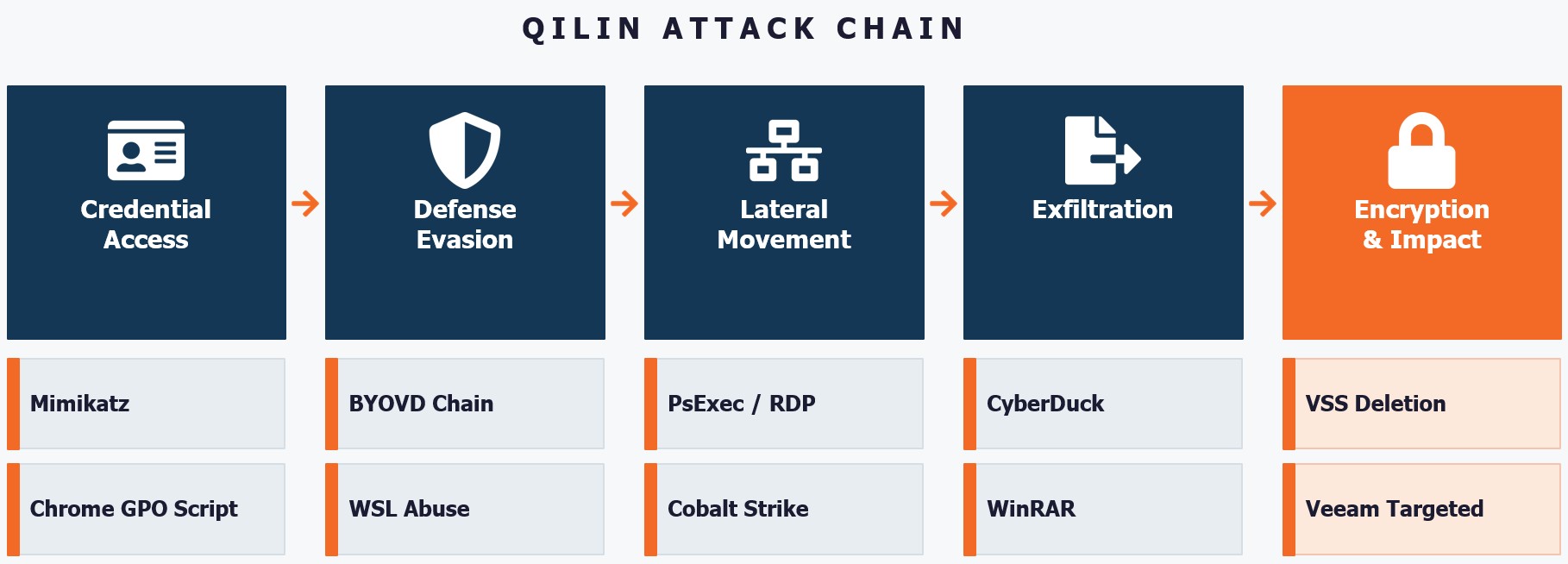
By the time many organizations detect a Qilin deployment, affiliates may have already moved through credential access, lateral movement, and exfiltration. The useful question for defenders is which controls can stop the intrusion before affiliates move from access to encryption.
Qilin’s affiliate model means tools and entry points can shift from one incident to the next, but defenders still see recurring pressure points: credentials, endpoint visibility, lateral movement, exfiltration, and backups. The controls that matter most are the ones that interrupt the attack at multiple points regardless of how an affiliate executes it.
Qilin is not a threat that organizations can patch their way out of once. The affiliate network continues to expand, the tooling evolves, and the targeting is broad. These controls exist because the attack chain gives defenders multiple opportunities to interrupt it, but only if those controls are already in place.
For a deeper look at Qilin's infrastructure, affiliate recruitment, and observed TTPs, see the MOXFIVE Threat Actor Spotlight: Qilin.



MOXFIVE provides the clarity and peace of mind needed for attack victims during the incident response process. Our platform approach enables victims of attacks to work with a Technical Advisor who provides the expertise and guidance needed in a time of crisis, and facilitates the delivery of all technical needs required, consistently and efficiently.
Learn More
With experience on the front lines responding to incidents daily, MOXFIVE Technical Advisors have the unique ability to connect the dots between business, information technology, and security objectives to help you quickly identify the gaps and build a more resilient environment.


