

The Situation
Growing by acquisition comes with a cost that rarely shows up on the balance sheet. For this healthcare group, years of M&A activity had built a sprawling, multi-entity operation with a distributed infrastructure that served the business well. Yet, building a company through acquisition is a little like renovating a house while people are living in it. Things get patched, systems get inherited, and somewhere in the shuffle, details fall through.
For this organization, that detail was three servers: file transfer, SFTP, and remote access. Endpoint protection covered most of the environment, the standard toolkit for a company of their size and complexity. But these three hosts had never made it onto the coverage map. No EDR and no firewall, meant no visibility. In the healthcare sector, where sensitive patient data and regulatory obligations compound every breach, that kind of quiet gap tends to stay quiet right up until it doesn’t. The Anubis ransomware group found it first. Compounding this challenge were several simultaneous crises:
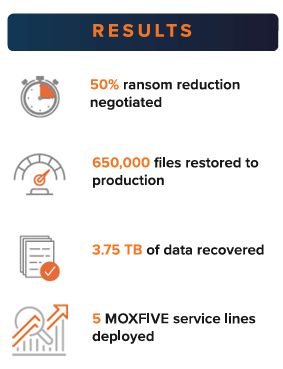
MOXFIVE deployed five service lines within 24 hours of the intake call. One firm with ownership of every workstream, with no handoffs and no subsequent context loss.
In addition to 50% off the initial ransom demand, the decryption tool was secured and recovery began without delay. By the time the restoration workstream closed, 650,000 files totaling 3.75 TB had moved from the disaster recovery site back into production. The exfiltrated dataset had been reviewed in full, PII and PHI scope confirmed, and the notification population identified with enough precision to satisfy HIPAA and applicable state obligations. Approximately 50 critically defined systems were restored within seven workdays, and a legally defensible forensic report and executive summary were in breach counsel’s hands.
Most post-breach assessments start with a framework. This one started with evidence. The three unprotected servers at the center of this incident weren’t identified through a compliance checklist or a theoretical risk model. They were identified because MOXFIVE’s forensic team reconstructed exactly what the attacker did and traced it back to its source. That distinction matters when the findings have to hold up in front of breach counsel, a carrier, and a regulator simultaneously.
The structure of the engagement mattered as much as the findings. Negotiations, forensics, restoration, data mining, and resilience planning ran concurrently, under unified leadership, from the same incident data. The resilience recommendations that followed were built on the same forensic foundation, providing a prioritized set of changes derived from what the breach actually revealed about the environment. That’s a different kind of advice, and it comes from a different kind of relationship with data.
Facing a similar situation?
MOXFIVE has managed thousands of ransomware incidents and ongoing resilience across industries, from initial response through recovery and regulatory notification. Talk to our team today at 833-568-6695 or incident@moxfive.com.